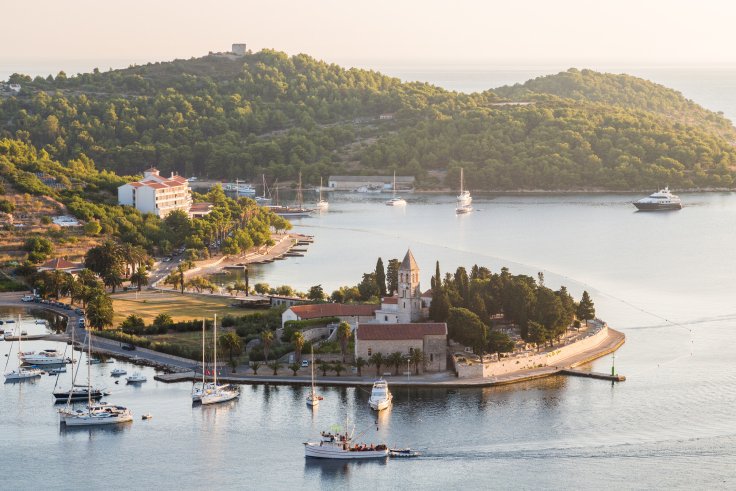
Croatia is one of Europe's best sailing destinations. More than a thousand islands, clear water, constant winds, and a coastline that looks completely different from the boat than from land. But between wanting to spend a week sailing around Dalmatia and understanding how it actually works, there are many unanswered questions. This article answers them: what happens during those seven days, what the skipper does, how much it costs, when to go, and what to pack.
-
Why is one week the right amount of time to sail around Croatia?
-
What are the advantages of sailing in Croatia for my sailing holiday?
-
How to get to Croatia to start a one-week sailing trip?
-
Example itinerary: 7-day route through Croatia starting from Split
-
Other activities you have to do during your 7 days sailing around Croatia
-
What do you learn by sailing for seven days in Croatia?
-
How can the boss help you during the holiday week?
-
Who is a skippered sailing trip for?
-
How much does a 7-day trip through Croatia cost?
-
The best time to sail in Croatia
-
What to pack for a week-long sailing trip?
-
Are you looking for a sailing trip around Croatia this summer?
Why is one week the right amount of time to sail around Croatia?
You can sail through Croatia in fewer days, but a week is the ideal amount of time to allow. The first two days are spent learning how the boat works, getting to know the crew, and understanding the rhythms of the Adriatic (for example, when the Maestral River flows in the afternoon or when it's best to leave early to cross a channel). From the third day onwards, all of that becomes automatic, and the trip and your overall experience improve significantly.
Seven days also allows you to cover the islands that are truly worthwhile without feeling rushed. From Split heading south, you can visit Brač, Hvar, Vis, Korčula, and Šolta with comfortable legs of two to four hours of sailing per day. If you have less time, you have to choose between islands and either miss the best ones or take long legs that don't allow enough time to explore. If you have more time, a second week calls for a different route, heading north to Zadar or to the Kornati National Park.
Furthermore, Croatian törns typically operate on a Saturday-to-Saturday schedule. Therefore, by taking five days off, you have nine full days away.
What are the advantages of sailing in Croatia for my sailing holiday?
The Adriatic is a shallow, enclosed sea compared to the open Mediterranean. This has direct consequences for sailors: the wind rises and falls quickly, waves form rapidly but also subside quickly, and the distances between islands are short. From Split to Hvar is about 25 nautical miles, a two- to three-hour sail. From Hvar to Vis, another 20 miles. This allows you to set out in the morning, sail for a few hours with the wind, and reach a calm anchorage before the heat becomes too intense.
The three winds that govern this coast are the Bora, the Jugo, and the Maestral. The Bora is a cold, dry northeasterly wind that can arrive with great force without warning, especially between October and March. The Jugo blows from the southeast, bringing humidity and a swell, and when it lasts for several days in a row, navigation becomes difficult. The Maestral is the summer wind: it blows in from the northwest in the afternoon, cool and steady, and it's the one that makes July afternoons unforgettable. A skipper who has spent years on these waters knows all three by heart and knows when to stay in port and when to head out.
How to get to Croatia to start a one-week sailing trip?
Most tours in Dalmatia depart from Split, which has direct flights from major European airports. Vueling, Ryanair, and other airlines operate direct flights, especially between May and October.
Split Airport is about 25 kilometers from the city center and the port. A taxi takes about twenty minutes and costs between 30 and 40 euros. There is also a direct bus to the city center for about 5 euros, although it can be inconvenient with luggage.
If the boat departs from another marina—Trogir, Kaštela, or Marina Agana, all very close to Split—the airport remains the most convenient option. Some skippers meet the crew directly at the marina on the day of embarkation to avoid any last-minute complications.
Example itinerary: 7-day route through Croatia starting from Split
There is no official route. Each skipper plans according to the wind, the season, and what both they and the crew want. But some itineraries are repeated because they work well. This is a classic seven-day route from Split that covers the best Dalmatian islands with realistic stages.
- Saturday (Split): Boarding from 5 pm, crew introduction and safety instructions. Overnight in port. Split's old town is a five-minute walk from the dock and is worth a stroll: Diocletian's Palace has entire streets within it.
- Sunday (Brač Island, Bol): First departure, two or three hours of sailing across the channel. Destination Bol, home to Zlatni Rat beach, a tongue of pebbles that changes shape with the wind and is the most recognizable image of Croatia. The boat remains in the marina or anchored off the coast.
- Monday (Hvar Island): Hvar is the most well-known island on this route. The old town is right next to the port, the fortress sits atop the hill, and from there you can see the entire bay. At night, it's the liveliest island in the entire Croatian Adriatic. For those who prefer tranquility, there are coves ten minutes from the main port where you can anchor in complete silence.
- Tuesday (Vis Island): Vis is the highlight of the week. Until 1989, it was a Yugoslav military zone and closed to foreigners. This saved it from mass tourism. Stiniva Cove—a white pebble beach nestled between two rock walls, accessible only on foot via a very steep path or by dinghy from a boat—was chosen by National Geographic as one of the most beautiful beaches in the world. The village of Komiža, on the west side of the island, has restaurants right on the water where you can dine well and at your leisure.
- Wednesday (Korčula Island): The town of Korčula is built on a small peninsula and from the sea looks like a miniature walled city. Venetian towers, narrow alleyways, a quiet harbor. It was supposedly the birthplace of Marco Polo, although that's still disputed by the Croatians and Venetians. A good midweek stop.
- Thursday (Šolta Island or free anchorage): Šolta is an island that almost no one mentions, but experienced skippers in the area know it well. Few people, excellent olive oil, and coves without charter boats piled up. If the wind is favorable, this day can also be a free anchorage day in an unnamed bay, one of those that doesn't appear in the guidebooks. Last night on board.
- Friday (Return to Split): Early departure, arrival at noon. Disembarkation, last breakfast on deck, end of voyage.

Navegando por Ciudad de Vis en Croacia
Other activities you have to do during your 7 days sailing around Croatia
A sailing trip around Croatia never goes exactly as planned, and that's usually a good thing. Here are some of the things that happen throughout the week that can't be included in a program:
- Snorkeling on volcanic seabeds: The waters of the central Adriatic have visibility of between 15 and 30 meters depending on the area. Anchoring in a cove in Vis or anywhere south of Hvar and snorkeling with a mask and snorkel will reveal octopuses, moray eels, schools of salema porgies, and, if you're lucky, a turtle. No scuba gear is necessary.
- Fishermen's markets in the harbor: In Komiža, Milna, or any small port along the route, in the mornings the fishermen come out with their catch from the night before. The skipper buys what's available—shrimp, octopus, dentex, sea bass—and that's dinner. It's one of the most distinctly Dalmatian things you can do.
- Dinners in konobas: A konoba is the Croatian equivalent of a village tavern: no menu in Spanish, no tourist menu, just whatever's available that day. The best ones on the route don't have websites or appear on Google Maps. The owner knows them because he's been going for years. Octopus peka—octopus cooked under an iron dome with embers for hours—is the dish you can't miss.
- Watching the sunrise from the deck: On nights at anchor in an open cove, with no artificial light around, the Adriatic sky has an almost unbelievable density of stars. And watching the sunrise from the deck, with the boat still and the water completely calm, is the kind of moment that photos simply can't capture.
- Sample local wines: Croatia has a serious wine culture that is largely unknown outside the country. Hvar produces Bogdanuša, a floral white wine served very chilled. Korčula has Pošip and Grk. Brač has wines made from indigenous grapes that are hardly exported. Each island offers something different, and spontaneous wine tastings in the harbor are a natural part of the week.
What do you learn by sailing for seven days in Croatia?
Nobody expects you to become a boss in a week, but whoever takes a trip like this comes back knowing things they didn't know before.
You learn to read the wind forecast and understand what it means when the wind shifts to the north in the afternoon. You understand why you set sail early in the morning—because in the Adriatic the wind usually cools down and the swell increases from midday onwards. You learn how to anchor, how to secure a mooring buoy, how to dock in a port when the wind is abeam. You see and do all of this on the boat, not in a classroom.
Most skippers who operate in Croatia with Sailwiz explain what they're doing as they do it. If you want to take the helm, they'll let you. If you prefer to watch, that's fine too.
How can the boss help you during the holiday week?
Sailing in Croatia without a license or experience is possible because the skipper is on board and takes care of all nautical matters. But their role goes beyond simply steering the boat.
Every night before going to sleep, he checks the forecast for the next day. He decides whether it's worth leaving early to take advantage of the calm morning before the Maestral wind arrives, or if it's better to wait. He knows which anchorages in Vis have good holding power and which don't. He knows that in August the Hvar marina fills up before noon and that you have to arrive early or find another spot. He knows of a cove in southern Brač that's barely mentioned in the guidebooks and where you can anchor with your boat completely alone.
That's what you're buying when you go with a skipper: years of experience on that specific coast, not a boat driver.
Some people who have a recreational boating license (PER) or the minimum qualification wonder if it makes sense to still go with a skipper. The answer many Croatian skippers give when asked is straightforward: sailing in Dalmatia is more demanding than it appears on the map.
The number of rocks and shallows not marked on standard apps is remarkable. Anchorages have very different holding conditions—some have rock under the sand, preventing the anchor from sticking. Local wind patterns change depending on which channel you're crossing and the time of day. In peak season, managing access to the most popular anchorages before they fill up requires knowing the timings and alternatives. With a skipper who has years of experience in the area, you save yourself all that trouble and make the most of every day.
Who is a skippered sailing trip for?
Because you can go with a skipper in calm waters and always close to the coast, the type of person or group of people can be very varied:
- No prior experience: This is the most common profile. The skipper handles the navigation; you learn along the way. No nautical qualifications or prior knowledge are required.
- Traveling alone: Single berths on shared cruises are a great option for solo travelers looking for something different. The crew is usually international, and spending a week together in a small space creates an atmosphere that few other travel options can match.
- As a couple, family, or small group of friends: You can book places on a shared trip or rent the entire boat for your group. Sailwiz offers both options. It's even a very comfortable trip to take as a family.
- With some experience: If you have already sailed and want to accumulate miles or meet a new sailor, the skipper can give you more prominence in the sailing if you agree to it beforehand.
How much does a 7-day trip through Croatia cost?
For a berth on a shared voyage, Sailwiz prices range from around €650 per person on a monohull sailboat to around €1,200 on a catamaran, depending on the season and the boat. In addition, there's a boat allowance, which covers shared expenses such as food, fuel, and port fees: this usually ranges from €150 to €250 per person for the entire week.
If your group wants the entire boat to yourselves, it can be chartered privately. For a group of four to six people, the price per person can be similar to individual berths, with the advantage that you decide the itinerary.
The best time to sail in Croatia
June and September are undoubtedly the best months. The water is warm, the coves are quieter than in summer, and the harbors have space. September has an extra advantage: the peak season is over, but the weather is still just as good.
On the other hand, July and August are peak season. The most popular coves off Vis or Hvar get crowded in the afternoons, the marinas are packed, and prices are higher. Those who have to go in the summer because of school dates won't have a problem—the skipper knows alternatives to the crowded spots—but if you have flexibility, it's best to avoid August.
And finally, May has almost empty coves and the lowest prices of the year. The water is colder and the weather is somewhat less predictable. For those who like sailing without crowds, it's the best month.
What to pack for a week-long sailing trip?
The first thing you should know is that it's best to travel without a hard-sided suitcase. There's no room on the ship. A soft travel bag or backpack of no more than 15 or 20 liters is all that will fit in a cabin.
The essentials: high-factor sunscreen—the sun's reflection burns faster than you think in the water—sunglasses with UV protection, quick-drying swimwear, a light fleece for evenings and watches, and white-soled, non-marking deck shoes. Keep seasickness pills in your pocket even if you think you won't need them.
What you don't need: lots of clothes. After a week, everyone wears the same thing every day, and nobody cares anymore. You need to be comfortable and have space on the boat. This is essential.
Are you looking for a sailing trip around Croatia this summer?
If you're looking for a specific trip—whether solo, as a couple, with friends, or in a group—Sailwiz offers a selection of
sailing trips around Croatia this summer, complete with real participant reviews, skipper profiles, and clear pricing for each listing. No forms to fill out, no phone calls required.
What did you think of this article?