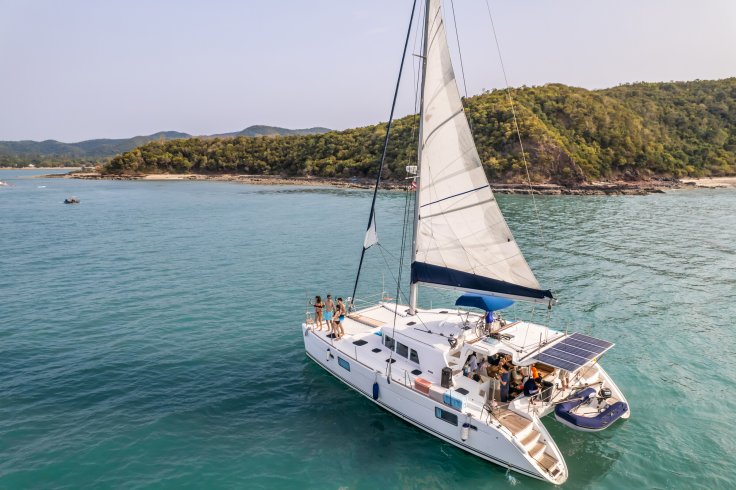
The cost of a week on a sailing boat depends mainly on three factors: the type of vessel (sailboat or catamaran), the season , and the number of people on board . On average, a shared sailing holiday with a skipper ranges between €650 and €1,200 per person per week, while for a catamaran the range increases approximately between €900 and €1,300 per person, depending on the level of comfort and the chosen period.
A sailing experience is often surprisingly competitive compared to other vacation options in popular tourist destinations, such as renting a beach house or staying in a hotel. In these cases, numerous additional expenses are added to the cost of accommodation: transportation to the beaches, daily travel, and restaurant meals. On a sailing boat, however, everything is concentrated in a single space: you sleep on board, move directly from one cove to another, and the boat effectively becomes your own "exclusive restaurant" overlooking the sea.
-
What is included in the price?
-
The galley
-
Moorings
-
Fuel
-
Sailboat or catamaran: which to choose?
-
Helpful tips for saving money when choosing a sailing holiday
-
Why some holidays cost twice as much as others
-
Exclusive boat: why it can be more convenient for groups
What is included in the price?
One of the most frequently asked questions, especially for those approaching this type of experience for the first time, concerns what is actually included in the price of a sailing holiday.
Generally, the fee includes the vessel, a professional skipper, and onboard equipment: everything needed to ensure an organized and safe navigation along the chosen itinerary. However, some variable costs related to daily life on board and managing the week at sea are not included. These include fuel, mooring fees, food and beverage supplies, and any shore excursions.
Overall, these additional expenses are generally managed through a shared fund among participants and tend to average between €150 and €300 per person per week, with variations depending on the destination, stops, and sailing style. The skipper or captain typically requests that the shared fund be set up upon embarkation, so as to simply and transparently cover shared expenses during the week.
In the case of "all-inclusive" packages, some of these expenses can already be included in the initial price, thus reducing the management of the common fund and making the experience even more linear and worry-free.
The galley
The galley is the food and beverage shopping organized by the crew upon arrival at the embarkation port. It's a shared moment where everyone decides what to buy for the week on board: the skipper can offer some practical advice, but the final decision always rests with the crew, who independently define their tastes and preferences.
Precisely for this reason, unless you opt for particularly sophisticated cuisine every evening, costs can remain quite reasonable. On average, for a week's sailing, the cost of food is around €150 per person, varying slightly based on the group's habits and the destinations.
Moorings
The cost of a night in port varies based on several factors, such as the size of the vessel, the time of year, and the marina chosen. Generally speaking, it can range from around 50 euros to over 200 euros in the central weeks of August, especially in the most popular and crowded destinations.
As you might imagine, the more touristy and centrally located the location is to the most popular routes, the higher the mooring price tends to be. For this reason, when conditions permit, skippers often prefer anchorage: a choice that's not only economical, but also experiential. Sleeping at anchor, far from the port, means finding yourself surrounded by the silence of the sea and a starry sky without artificial lights, one of the most authentic forms of life on board and, in many cases, even free.
Fuel
Since it's a sailing holiday, most of the time, wind permitting, is spent under sail. This means that engine use is kept to a minimum, with a limited impact on fuel consumption.
Actual fuel consumption depends primarily on the size of the vessel and the engine power. In a typical week, on a medium-sized boat, assuming about 30 hours of motor cruising, fuel costs generally range between €200 and €250 overall.
Sailboat or catamaran: which to choose?
The choice between a sailboat and a catamaran is one of the aspects that influences the overall experience at sea and the cost, both in terms of comfort and atmosphere on board.
A
monohull sailboat represents the true essence of sailing: more dynamic, essential, and deeply connected to the wind and the route. Spaces are generally more compact, but the experience is often more immersive for those seeking direct contact with the sea and the sailing itself. A
catamaran , on the other hand, offers a more spacious and stable environment. Common areas are more generous, cabins more independent, and the sensation of movement is reduced, especially at anchor. For this reason, it is often chosen by families, groups of friends, or those who prioritize comfort without sacrificing life at sea.
There is no absolute best choice: it all depends on the type of experience you want to have, the group you are traveling with, and the level of comfort you desire.

Catamaran holidays
Helpful tips for saving money when choosing a sailing holiday
There are a few simple things that can make a big difference in the final cost of a sailing holiday, without compromising the quality of the experience.
Choosing destinations easily accessible by car, train, or ferry can help significantly reduce overall travel costs. If your desired destination is only accessible by plane, it's best to book well in advance to get the best fares.
Group composition also plays a significant role: traveling with larger crews allows you to share expenses like fuel, mooring fees, or food among more people, making the overall experience more affordable. Likewise, avoiding peak season weeks can make a big difference, as even just moving your departure date up a few days can result in significantly lower prices.
Finally, keeping an eye on early booking offers and booking early often allows you to access the best available boats and conditions, as well as more competitive rates.
Why some holidays cost twice as much as others
Not all sailing holidays have the same price, even when they may seem very similar at first glance. The difference, in fact, is linked to a series of variables that directly impact the final cost and are often not immediately apparent to those approaching this type of experience for the first time. Among the main factors is the type of vessel: a newer sailboat, with more spacious cabins and modern amenities, or a large catamaran, inevitably entails higher costs than simpler or standard-category vessels.
Season also plays a key role. During peak season months, such as July and August, demand increases significantly, which is reflected in prices, both for boats and for services in the most popular ports and destinations. Conversely, during shoulder season, it's often possible to find better deals while still enjoying ideal sailing weather conditions. Finally, another key factor is the chosen destination . Sailing in particularly popular or touristy areas, such as some Greek islands or the Balearic Islands in the height of summer, can significantly impact the overall cost compared to less crowded routes or quieter periods.
In some cases, you can also find " all-inclusive " packages, where a larger portion of the services are already included in the initial price. This can include, for example, some on-board costs or more centralized management of daily expenses, thus reducing the variables to manage throughout the week and making the experience simpler and more straightforward from an organizational standpoint.
Exclusive boat: why it can be more convenient for groups
Another factor that significantly impacts the final cost is the group's composition. When traveling with a group of friends or multiple families, it can often be more cost-effective to consider renting the entire vessel exclusively.
In this case, the cost of the boat is split among all participants, allowing for optimized per-person spending and, at the same time, greater freedom in managing the week. On board, you won't share space with other external crew members, allowing for a more personalized experience, with greater flexibility in choosing your own pace, itinerary, and time of day. For large groups, this solution often offers a good balance between budget control and comfort, especially in the most popular Mediterranean destinations.
What did you think of this article?
The average rating is 5/5