On August 12, 2026, the moon will completely cover the sun at sunset over the Mediterranean. Mallorca will be at the center of this event, and this phenomenon will not be repeated on the island until 2180.
The island has something unique to Spain: the longest coastline in the country, the best August weather on record across the entire region, and miles of shoreline with the horizon stretching directly to the sea. But not all of Mallorca is created equal. Knowing exactly where to stand makes all the difference between seeing it and missing it.
-
Why is Mallorca the endpoint of the totality zone?
-
The exact details of the eclipse in Mallorca
-
Why not all of Mallorca will see it the same way: the map explanation?
-
What happens minute by minute during the eclipse
-
What experts and institutions say
-
Why does viewing it from a boat solve all problems?
-
The best ports from which to set sail
-
The greatest risk to institutions will be trafficking.
-
Where to stay to be well located
-
What to do in the days before and after?
-
Practical tips for viewing the eclipse
-
Book your boat with Sailwiz to see the eclipse
Why is Mallorca the endpoint of the totality zone?
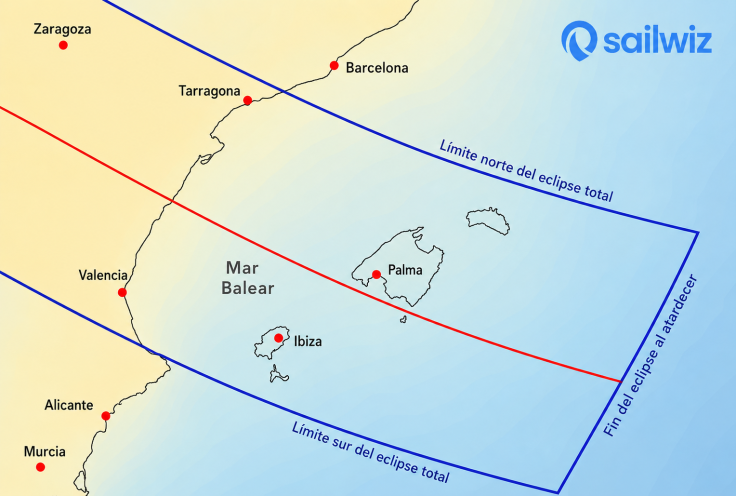
The path of totality for this eclipse begins in the Arctic Ocean, crosses Greenland, traverses the Atlantic, and enters Spain through Galicia. It travels across the Iberian Peninsula from northwest to southeast and ends directly over Mallorca, where the eclipse coincides with sunset over the Mediterranean.
That detail changes everything. Mallorca isn't just the last point in Spain within the eclipse zone: it's the point where the eclipse is seen with the sun at its lowest point in the sky, practically on the horizon. The solar corona will appear at water level. When that happens, the Mediterranean acts like a mirror, doubling the spectacle. There's no other place in Spain where this combination occurs.
In terms of duration, Palma will experience approximately 1 minute and 36 seconds of totality, the highest value in all of Spain. And the map of the solar path places Sóller exactly on the central line of totality, the axis where darkness is at its maximum and longest.

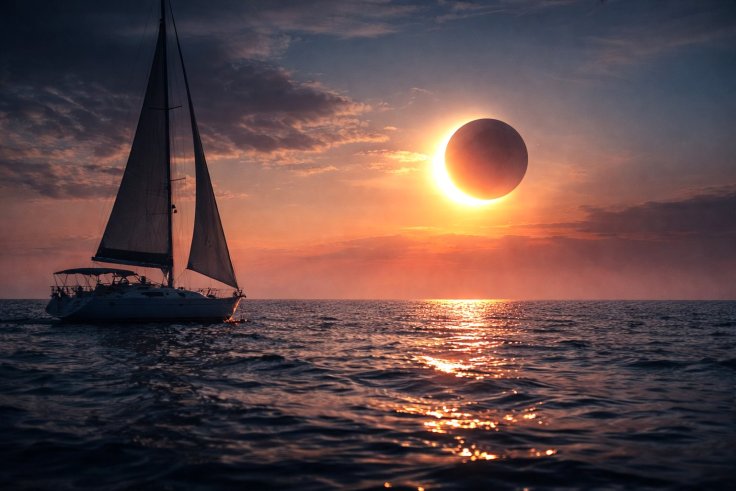
Vista del eclipse total por las Islas Balerares
The exact details of the eclipse in Mallorca
The partial eclipse begins at 7:37 p.m., when the moon starts to clip the edge of the sun. Totality begins at 8:31 p.m., lasts 1 minute and 36 seconds, and ends at 8:32:36 p.m. At that moment, the sun is only 2° above the western horizon. The eclipse ends at 8:46 p.m., and the sun sets almost simultaneously.
During those 96 seconds of totality, Venus, Jupiter, and Mercury will be visible in the darkened sky alongside bright stars. In the middle of August, in the middle of the evening, planets and stars over the Mediterranean.
Why not all of Mallorca will see it the same way: the map explanation?
Here is the fact that most people are unaware of and that the Fundació Institut d'Astronomia i Astronàutica de Mallorca (FIAAM) has been explaining for months: the interior of the island, for the most part, will not see the eclipse in its totality.
The reason is purely geometric. The sun will be only 2° above the horizon when totality occurs. At such a low altitude, the mountains and the interior terrain of Mallorca obscure the western horizon at the crucial moment. From Puig de Randa, Puig de Sant Salvador in Felanitx, or Puig de Santa Magdalena in Inca, the western terrain can hide the sun before totality arrives.
The maps produced by FIAAM clearly show this: the yellow area—where the eclipse will be fully visible—is a coastal strip. The red interior of the island, including much of Palma, will experience a partial eclipse or incomplete totality due to the terrain.
According to FIAAM, the best conditions are concentrated in the Serra de Tramuntana, the southwest coast between Andratx and Calvià, the coastline between Cap de Regana and Cap Blanc in Llucmajor, and the coastal strip from Colònia de Sant Jordi to Cap de ses Salines in Santanyí.
The conclusion is straightforward: you need to be on the coast, facing west, with a completely unobstructed view of the sea. Anyone inland or in an urban area is very likely to miss the entire view, even if they are within the clear area.
What happens minute by minute during the eclipse
From 7:37 p.m. the moon begins to nibble at the edge of the sun. The light slowly changes for almost an hour, becoming colder and stranger. The shadows sharpen in a way that can't be described until you see it.
Around 8:15-8:20 pm, with more than 80% of the sun obscured, the temperature begins to drop several degrees. The animals react: the birds fall silent, the bees return to the hive.
In the minutes leading up to 8:31 p.m., darkness falls swiftly. The horizon in all directions is simultaneously bathed in the colors of dawn. From the sea, with a clear 360° view of the horizon, this circular twilight phenomenon is seen in all its splendor.
At 8:31 p.m., the sun disappears. The solar corona is exposed above the Mediterranean horizon. It's time to take off your sunglasses and look directly at it. It lasts 96 seconds. It's not something you can get back.
What experts and institutions say
The institutional preparations for this eclipse are unprecedented in the Balearic Islands. The Balearic Government, the island councils, the Federation of Local Entities, the FIAAM (Federation of Associations of Astronomy of Mallorca), the Astronomical Observatory of Mallorca (OAM), and the Astronomical Association of Mallorca (AstroMallorca) are working together in a permanent commission created specifically to manage the event.
Councilor Estarellas has publicly warned that temporary road closures could be implemented to prevent traffic gridlock. The Council's Department of Roads and the Government's Directorate General of Emergencies are already working together on traffic measures. FIAAM has produced a specific map of potentially problematic points, identifying the roads at highest risk of gridlock that day.
The roads identified as problematic by the FIAAM are the Formentor road, the Cap Salines road, the Valldemossa road, the Sóller road, and the Son Gual road. All of them provide access to prime viewing areas and are narrow roads with no alternative routes. A blockage on any of them could leave hundreds of cars stranded when the event begins.
FIAAM has also conducted timed sunset tests from various points on the island—Andratx, Manacor, Santa Eugènia—to precisely determine the optimal viewing locations. These tests form the basis of their official recommendations.
Why does viewing it from a boat solve all problems?
The maps above make it very clear. You have to be on the west coast with a clear view of the sea. The ship perfectly fulfills this condition and also solves the main problem anyone trying to see it from land that day will face: traffic.
With the sun at 2° above the horizon, the horizon is always guaranteed from the deck. There are no buildings, no palm trees, no parked cars in front. And if there are clouds, the skipper can reposition the boat by consulting real-time satellite images. On land, with roads closed or gridlocked, that's impossible.
Water adds a dimension that doesn't exist from land. The solar corona is reflected in the Mediterranean. The moon's shadow moving across the sea is visible to the naked eye. The circular twilight that surrounds the horizon during totality is visible in all four directions without interruption.
The National Geographic Institute (IGN) has published an interactive map viewer where the exact duration of totality can be checked from any marine coordinate. Skippers can use this tool to precisely position themselves at the point of longest darkness.
If you want to experience all of this on August 12th, Sailwiz offers special departures from Mallorca and other points along the Spanish coast. Sailboats and other vessels with professional skippers are available, but spaces are very limited.
Check out all the available experiences for the solar eclipse.
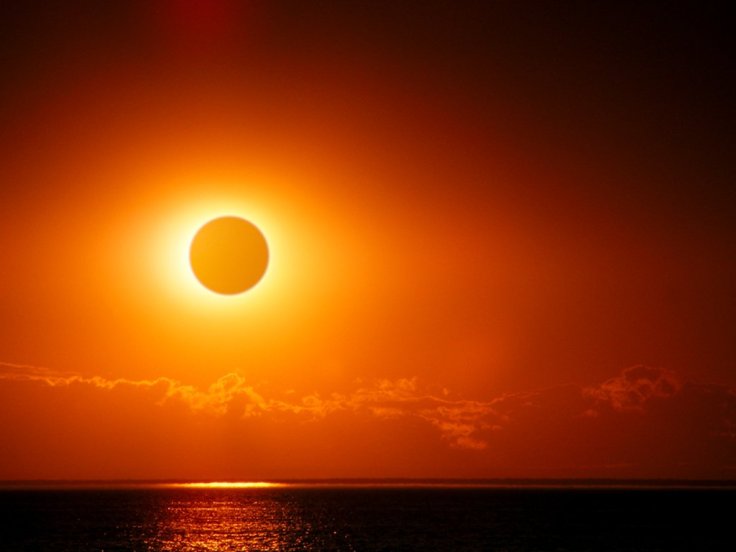
Vista del eclipe desde un barco
The best ports from which to set sail
- Port de Sóller: It lies on the central line of the entire area according to the map of the coastal strip. It faces directly west, with quick access to the open sea facing the Tramuntana mountains. It can be reached by the historic train from Palma and the tram to the dock.
- Port of Pollença: Departure towards Cape Formentor with the silhouette of the mountain range accompanying the eclipse. Clear horizon to the west over the sea.
- Port of Alcúdia: Wide perspective with Formentor on the right and the eclipse developing over the north coast.
- Port of Andratx: Direct access to the western Mediterranean. Less crowded than the northern ports and with access to the southwest coast designated by the FIAAM as an area of good visibility.
Important: From Palma Bay, the full sun will not be visible due to urban obstructions. From Sant Elm, the island of Dragonera partially blocks the sun at the critical moment. FIAAM confirms this on its maps.
The greatest risk to institutions will be trafficking.
The Balearic Government, the island councils, and FIAAM have been working on traffic management plans for months precisely because they know what's coming. Councilor Estarellas has publicly acknowledged that roads could be temporarily closed. This means that anyone who doesn't plan well in advance could literally be stranded on the road when the closures occur.
The most problematic roads, according to FIAAM, are the Formentor road, the Cap Salines road, the Valldemossa road, the Sóller road, and the Son Gual road. All are narrow, with sharp curves and no alternative routes. You need to choose your viewing spot well in advance, arrive very early, and have a backup plan in case the road is closed.
The alternative that avoids all these problems is the boat. Anyone on the water from 6:30 pm onwards has no traffic lights, no parking, and isn't dependent on any road.
Where to stay to be well located
The northwest coast—Sóller, Deià, Banyalbufar, Valldemossa—is the most strategic area if you want to be close to the best viewpoints or start your trip from Port de Sóller. Sóller is right on the central ridge of the entire coastline. Availability is very limited and prices are high. If you haven't booked accommodation here, act now.
The northern area, with Pollença and Alcúdia, offers more options and direct access to the northern ports and Cape Formentor. It's probably the best balance between strategy and availability right now.
Palma and the southwest offer more price options, but be aware that traffic will be heavy that afternoon. The FIAAM warns that even the Valldemossa road could become gridlocked.
What to do in the days before and after?
The night of August 12-13 coincides with the peak of the Perseid meteor shower. From any point in the Tramuntana mountains with no light pollution, you can go directly from the eclipse to the shooting stars. Two astronomical phenomena on the same night over the Mediterranean.
The villages between Valldemossa and Pollença—Deià, Sóller, Fornalutx, Banyalbufar—deserve a leisurely visit before the eclipse floods the island. Arriving a couple of days early is the wisest way to make the most of your trip and secure accommodation in the right area.
At Sailwiz, we offer multi-day sailing itineraries from Mallorca to Formentera or Menorca that combine island hopping with the eclipse as the grand finale. It's a way to make your trip more than just a 96-second event.
Practical tips for viewing the eclipse
ISO 12312-2 certified glasses are essential throughout the partial phase. You can only look without a filter during the 96 seconds of total exposure. Regular sunglasses are not suitable and can cause irreversible retinal damage.
Bring warm clothing even though it's August. The temperature drop is more noticeable at sea due to the wind.
Charge all devices the night before. There are no outlets on a cliff lookout or deck.
Don't get obsessed with taking photos. You have 96 seconds. Take your pictures, but then put the camera down and look with your eyes.
Vive el eclipse en Mallorca desde el mar
Book your boat with Sailwiz to see the eclipse
The sea solves the two major problems of the eclipse in Mallorca: the horizon and traffic. With the boat on the water from 6:30 pm, the western horizon is guaranteed and there are no roads.
At Sailwiz, we offer departures from Mallorca and other points along the Spanish coast, including Galicia, where the first light of night falls over the Atlantic. Sailboats and boats with professional skippers are available for all budgets.
What did you think of this article?
The average rating is 5/5