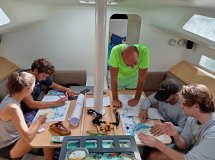
The RYA Coastal Skipper / Yachtmaster Shorebased course is the Royal Yachting Association (RYA)'s advanced knowledge pathway, designed to transform an experienced yachtsman into a skipper capable of planning and conducting complex offshore voyages, both day and night.
What is the RYA Yachtmaster Shorebased course?
This is an intensive theoretical module focusing on planning, in-depth meteorology and safety rules at sea.
Designed for those who have already absorbed the theoretical foundations of the RYA Day Skipper course, this course raises the bar significantly, introducing the calculation of complex tides, planning offshore crossings and managing emergencies and adverse weather conditions.
The course represents the fundamental theoretical step for anyone wishing to take the practical exams to obtain the RYA Coastal Skipper** or RYA Yachtmaster Offshore (both sailing and motor).
Program and Main Topics
The curriculum covers in detail all the key aspects of offshore sailing:
Charting: Determination of the ship's position by dead reckoning and estimated position, visual and cross-bearing, use of integrated position lines and evaluation of the margin of error or area of uncertainty.
Tides and Currents (Tidal Navigation): One of the course's cornerstones. It explores the calculation of tides for secondary ports, tidal anomalies, the impact of tidal streams on course-to-steer, and the management of shallows or critical passages in the presence of strong tidal ranges.
Applied Meteorology:
Interpretation of synoptic charts, analysis of frontal systems and air masses, study of the Beaufort scale, formation of maritime fogs and local breezes. Students will learn how to forecast the weather by combining official bulletins, barometric analysis, and direct observation of the sky.
Passage Planning:
A comprehensive strategy for preparing for coastal and offshore crossings. It includes passage planning, waypoint management, night navigation tactics, and pilotage planning using beacons, light sectors, and alignments.
Electronic Instrumentation: Integrated use of GPS, chartplotter, depth sounder, log, and radar. The limitations of electronic navigation, the use of vector and raster charts, and the importance of consistently cross-referencing data with paper nautical charts are analyzed.
COLREG (International Regulations for Preventing Collisions at Sea): In-depth study of all rules of precedence, light and sound signals, and conduct of crew members in case of reduced visibility or heavy traffic.
Safety and Emergency ProceduresNaNboat preparation for bad weather, vessel stability, use of life rafts, distress signals, helicopter rescue procedures and knowledge of customs and international regulations.
Structure and Requirements
Approximate duration:
Approximately 40 hours of face-to-face or online lessons, plus approximately 15-20 hours of individual study and a final written exam (usually divided into three modules: Correspondence, Meteorology/Planning, and COLREG).
Recommended prerequisites: Theoretical knowledge equivalent to RYA Day Skipper Shorebased level or Unlimited boating licence. A reasonable amount of practical experience with sailing or motorboating is also recommended.
Language: The course and exam are held entirely in English, which is essential since all nautical terminology and RYA cartography adopt the British international standard.
Who is it aimed at?
The RYA Yachtmaster Shorebased course is the ideal choice for:
1. Experienced boaters who wish to navigate safely on offshore routes and at night, mastering dead reckoning, electronic navigation, and in tidal waters.
2. Aspiring marine professionals who wish to obtain RYA commercial qualifications (Yachtmaster Coastal or Offshore) to work on charter, megayacht or commercial vessels.
3. Anyone who wants to acquire a solid, standardized nautical planning structure recognized worldwide for its rigor and completeness.
Read more